 SSY
SSYTime blindness - why five minutes feels like twenty
If 'just five more minutes' has eaten your whole afternoon, you aren't bad with time. Your brain is built differently around it.
May 3, 2026 · 5 min read

You look up from a task certain that twenty minutes have gone by. It has been three hours. Or the opposite - you're sure you have plenty of time, you'll leave in a minute, and somehow you're late again. This is one of the most disorienting parts of having an ADHD brain. The world keeps a clock. Yours forgets to.
The phenomenon has a name. Russell Barkley, the researcher who has spent decades on the executive-function side of ADHD, started calling it time blindness - or, more clinically, temporal myopia - in a 1997 paper on self-regulation and time perception. It is not a metaphor. It describes a measurable difference in how the ADHD brain estimates duration, plans against deadlines, and feels the passage of time itself.
The 30 to 40 percent gap
When researchers put adults with ADHD through standard time-perception tasks - estimate how long this clip lasted, reproduce a duration you were just shown - the same finding keeps coming back. Studies have found that people with ADHD consistently underestimate elapsed time by something like thirty to forty percent. A 2017 study on childhood ADHD looked at multiple timing mechanisms at once and concluded that the deficit is global, not narrow. It shows up across timing tasks. It isn't specific to one kind of clock.
That gap is what makes the lived experience so confusing. You weren't trying to be late. You actually believed you had time, because your brain quietly told you so, and your brain was wrong by a third. It's hard to plan against an internal sense that's systematically off.
Now versus not now
Barkley describes the ADHD brain as living in a kind of binary present. There is "now" - the thing happening to you, in front of you, this moment. And there is "not now" - everything else. The not-now category is flat. A deadline twenty minutes away and a deadline two weeks away both sit in the same vague distance, and both feel comfortably far until something flips them into now.
This is why a tax return that has been on the calendar for two months can feel relaxed on Monday and become an emergency on Thursday night. The deadline didn't move. It crossed the now-versus-not-now line. The whole sense of how much runway you had, you constructed yourself, in a brain that doesn't track time linearly the way you assumed it did.
Why this isn't a willpower failure
The prefrontal cortex regulates time perception. In ADHD it shows reduced activation during sustained attention, which is the cognitive state in which time perception lives. Dopamine - already lower at baseline in the ADHD reward system, per Volkow's PET imaging work - also plays into temporal discounting, the process by which the brain values rewards based on how soon they'll arrive.
A 2017 paper on executive functioning, temporal discounting, and sense of time in adolescents with ADHD found that future rewards get steeply discounted - they feel less real, less compelling, than they should. That is a real, neurobiological effect. It's not that you're deciding the future is unimportant. It's that the future is, to your brain, a thinner thing.
Trying harder doesn't make a clock visible
Most advice on time management for ADHD asks you to feel time better. Be more aware of it. Pay closer attention. This is roughly equivalent to telling someone with poor eyesight to try harder to see. The whole point of time blindness is that the internal sense isn't reliable. Asking it to do more work doesn't make it more accurate - it just makes you tireder, and a little more ashamed of being late again.
What works better is externalising time. Putting it outside your head, where you can see it. A visible timer counting down on the screen. A guess for how long the task will take, written down before you start, so you can compare it to how long the task actually took. Over weeks, those guesses calibrate. You stop being surprised. The clock isn't in your head - it's on the desk - and that's the whole point.
What this looks like in Mossy
When you write down a task in Mossy, you give it an estimate - five minutes, twenty minutes, an hour. The day adds them up: "1h 15 min planned." That single number is the antidote to "I have plenty of time." It tells you, before the day starts, how much room you actually have. If the planned total is bigger than the day, the day will spill, and you can decide what to move now instead of finding out at six in the evening.
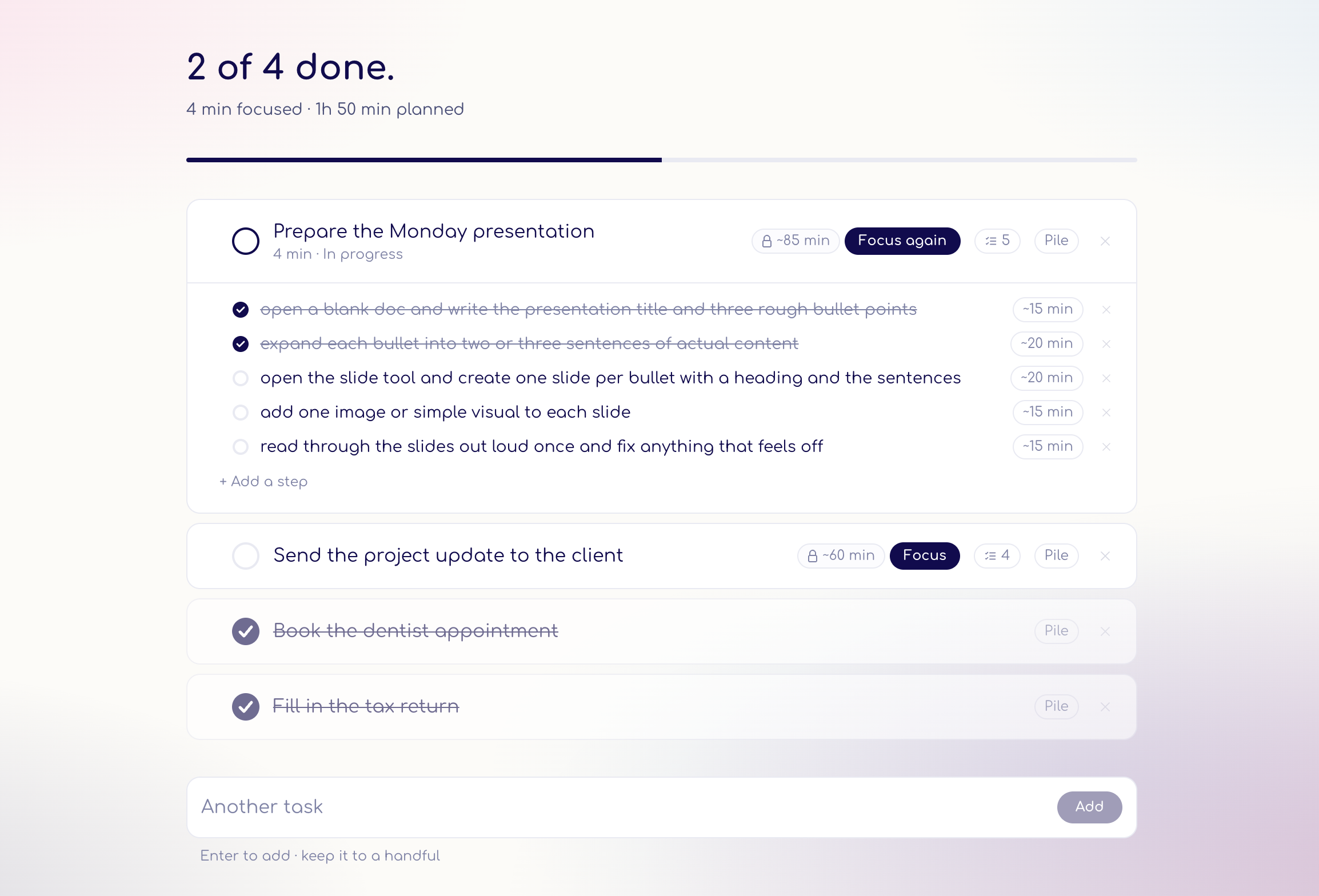
The focus timer takes the same number and runs it. You can see the time leaving. When the block ends, the block ends - you don't have to feel for it. After a couple of weeks of this, you start to notice the gap between what you thought a task would take and what it actually took, and the gap closes a little. That's calibration. It's slow. It's also the only thing that has ever worked, because it isn't asking your time-blind brain to suddenly start seeing time.
You're not bad with time
If you've grown up being late, getting lost in projects, missing deadlines you absolutely intended to hit, you've probably absorbed the story that you're bad with time. That's not the right frame. You have a brain that doesn't quietly track time for you. That's not a personal flaw to be embarrassed about. It's information about what tools you need.
The tools are simple. Make time visible. Estimate before you start. Compare afterwards. Use a timer that's louder than your sense of time. None of this is a personality upgrade. It's just a workaround for a thing your brain genuinely doesn't do, and that workaround can be there every day, without judgment, until showing up on time stops feeling like an act of heroism.
References
- Barkley - ADHD, self-regulation, and time: toward a more comprehensive theory (Psychological Bulletin, 1997)
- Clinical implications of the perception of time in ADHD (review)
- Living in the Fast Lane - global perceptual timing deficit in childhood ADHD (Frontiers in Human Neuroscience, 2017)
- Executive functioning, temporal discounting, and sense of time in adolescents with ADHD
Mossy is a gentle planner and focus companion built for ADHD brains. No streaks, no shame - just one step at a time.